The Olive Grove
One hundred trees that were here before us.
Two hectares of red Pugliese earth, one hundred centenary olive trees, and one tree in particular — the one at the heart of the courtyard, around which the whole house was redrawn.
The grove around the house
The estate is two hectares of olive grove on the gentle slope above San Vito dei Normanni. Roughly one hundred trees, most of them between one and two centuries old, planted in the irregular Pugliese rhythm — not the tidy alleys of an industrial orchard, but the slow geometry of a place that grew up around its own trees. Several are old enough to have stood through the late Kingdom of Naples and into the present without ever being moved.
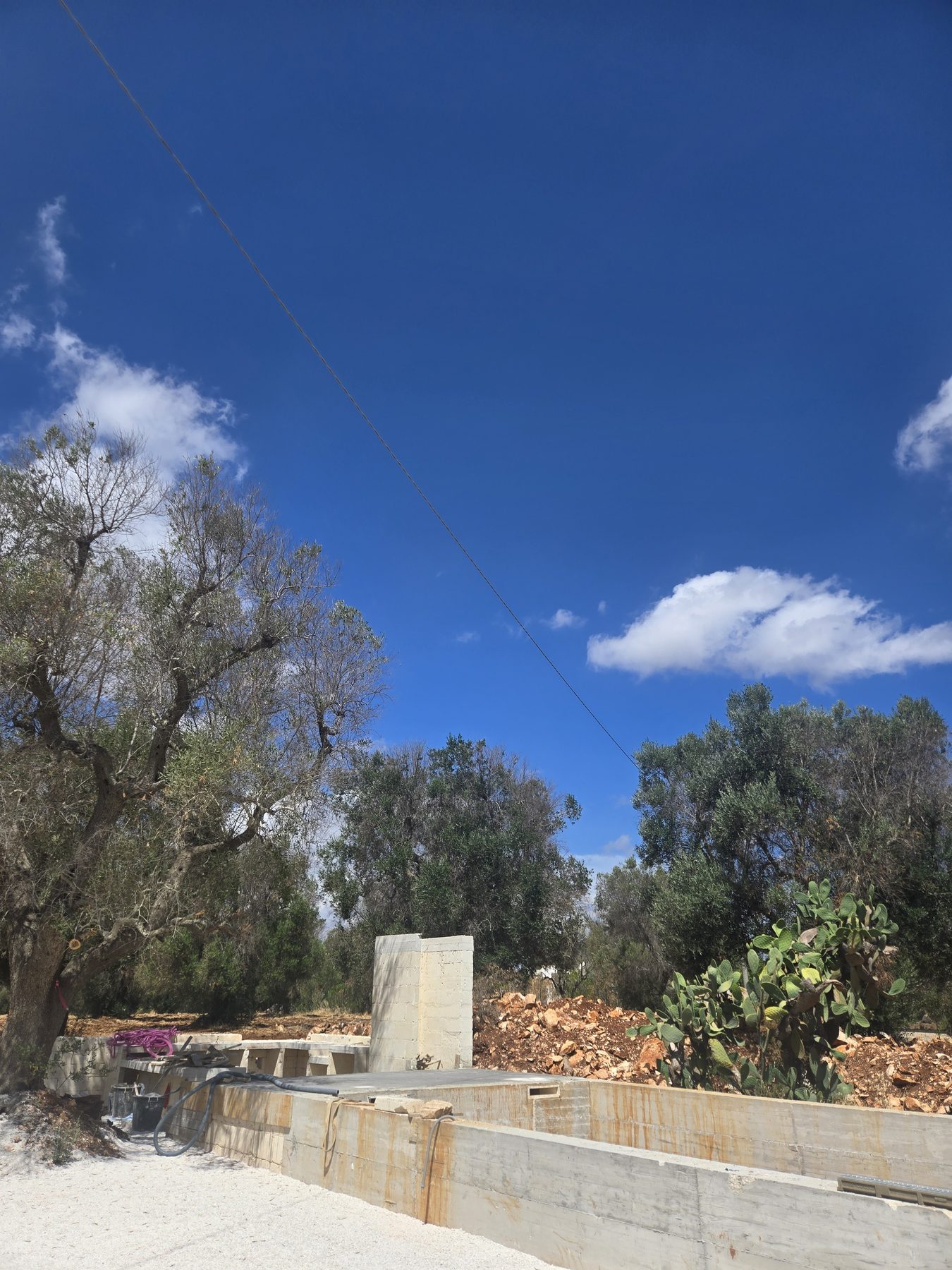
The macchia at the edges — wild fennel, lentisk, prickly pear, a few stubborn carob — has been kept rather than cleared. The understory is part of the grove. The hens patrol it in the morning. The cicadas take over at noon.
The land sits on the red terra rossa of the Salento — a thin, iron-rich soil over limestone, the kind that ripens olives slowly and gives a peppery edge to the oil. We do not irrigate. The trees drink the autumn rains and the winter mist, and live on what they can find through the dry month of August.
Two varietals
Ogliarola and Cellina, side by side.
Almost every grove in the Salento is a quiet conversation between two cultivars. Ours is no different. They flower together, they are picked together, and they end up in the same bottle — but each brings its own character to the oil.
Ogliarola Salentina
The soft one
- Fruit
- Small, oval, slow to colour. Turns from green to violet to black on the same branch.
- Harvest
- Mid-October to early November, in the first pass.
- Yield
- Generous in alternate years — the tree rests one season in two.
- Oil profile
- Soft, golden-green, almond and ripe tomato. Light pepper. Long, round finish.
- In the kitchen
- For raw use — on burrata, on fish, on warm focaccia.
Cellina di Nardò
The bright one
- Fruit
- Slightly larger, rounder, holds its green colour longer.
- Harvest
- From early November, in the second pass.
- Yield
- Steadier from year to year. The workhorse of the grove.
- Oil profile
- Intense green, cut grass and artichoke, marked bitterness, a clear pepper kick at the back of the throat.
- In the kitchen
- For finishing — on bean soup, on grilled vegetables, on bread with sea salt.
Almanac
A year in the grove, month by month.
The olive tree has a slow calendar. It rewards patience. Most of the year nothing visible is happening — and yet something is always being prepared.
-
January — February
Pruning. The slowest, quietest work of the year. We open the canopy so that a swallow could fly through it — the old Pugliese rule. The cut branches are stacked at the edge of the grove and burnt at dusk, the smoke low and sweet.
-
March
The ground wakes up. Wild fennel, asparagus and borage push through under the trees. The macchia is still wet from winter. A first light tilling, only where needed.
-
April — May
Flowering. The mignola, the tiny cream-coloured cluster of olive flowers. Days where the whole grove smells faintly of honey. Most of these flowers will fall; only a few will set fruit. The wind decides.
-
June — July
Fruit set, then heat. Small green olives appear, hard as buckshot. The grass dries. The cicadas start, and don't stop until September.
-
August
The dry month. The trees pull water from deep down. We walk the grove at dawn before the heat. Nothing else.
-
September
The fruit hardens. Colour begins to shift on the south-facing branches. The nets come out of the shed and are checked, mended, folded ready.
-
October — November
Harvest. Two or three passes, by hand, spread across two to three weeks. Ogliarola first, Cellina after. Each day's pick goes to the mill within hours.
-
December
Rest. The new oil is on the shelf, vivid green, almost cloudy. The trees go quiet again. We start to think about pruning.
From tree to bottle
How the oil gets made.
Short version: nothing clever. The whole point is speed and cold. Every step is designed to keep the fruit from oxidising — that's where bitterness becomes flatness, and green becomes brown.
-
Pick
By hand, with light combs and nets laid on the ground. No shaking machines, no falls. Bruised fruit ferments on the way to the mill, so we move slowly and carry small crates.
-
Clean
Leaves and twigs are blown off in a current of air at the mill. The olives are washed in cold water — just enough to take the dust off, never enough to soak.
-
Crush
Stone-mill or hammer-mill — both are used in our village. The fruit, pit and skin together, becomes a thick green paste in a few minutes.
-
Malaxate
The paste is stirred slowly in a covered vat, never above twenty-seven degrees. This is what cold-pressed actually means: the temperature is held down so the aromatics stay in. Twenty to thirty minutes, no more.
-
Separate
A horizontal centrifuge spins the paste; the oil rises out. From orchard to first oil, less than six hours — often closer to four. That is the whole game.
-
Decant and bottle
The new oil rests in stainless steel for a few weeks, lets its sediment settle, and then goes into dark glass bottles. We do not filter. The young oil is faintly cloudy and that is how we like it.
One tree, at the centre
When Claudio Monnini, the architect, made the first sketch of Casa Andrea in August 2022, he placed a single centenary olive at the geometric centre of the courtyard. Every line of the project — the two new wings, the pool, the stone steps — was bent around that one tree. The casale sits on one side of it. The bedrooms open onto it from the other. The rooftop bureau looks down at it from above.
It is the tree you see first when you walk through the gate. The one the light falls through at five in the afternoon. The one the children will inevitably try to climb. It has a name only within the family, and we have no plans to publicise it.
We tell the longer version of how the project was drawn around it in a separate note: An olive tree at the heart of a house.
What you take home
A bottle of the year's pressing, wrapped in paper, in the canvas bag by the front door. The smell of olive leaves still on your hands after pulling a branch through your palm. A peppery aftertaste at the back of the throat that follows you to the airport.
And — if you slow down enough — the sound of cicadas at noon, which is the sound the grove makes when nobody is listening.
The grove is the reason the house is shaped the way it is. Coming to stay here means living inside it for a week or two — under the canopy, around the trunk, with the oil on the table.